
Hello, and welcome!
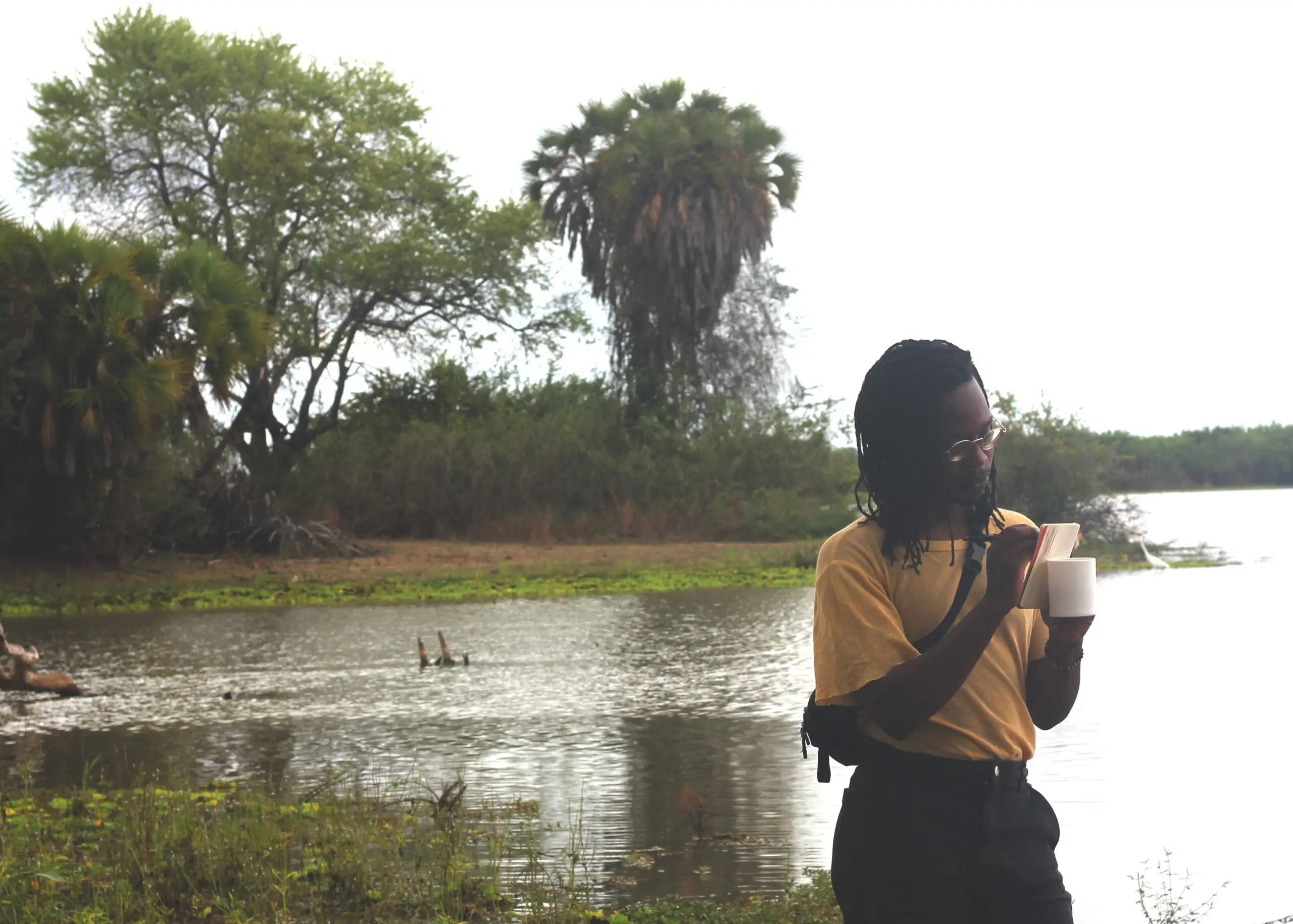
My name is Muindi Fanuel Muindi. I am a philosopher, poet, and curator, and I have come to Refracting Africa as a kind of writer in residence. As a writer for the Refractive Index, I am the one who tends the words while my sister, Nyamisi, who founded this Refracting Africa, tends the road.
Refracting Africa is leading travelers through Tanzania first, and then further into the continent and outward across the diaspora. She asked me to write for her because the words I write and the roads she walks mirror each other. So think of these postings less as travel brochures and more as travel companions. I am glad you are here!
Telling you a bit about where I come from tells you almost everything about why I am here, so let’s begin there.

An Origin Story
I was born in New York City, to a mother and a father who were born in Tanzania. So Tanzania has always been, for me, both the place I am from and a place I return to. I have been returning my whole life, for thirty-nine years, the homecomings growing more frequent as I have grown, and more frequent still since we laid my mother and father down to rest in Tanzanian soil, beside our people, in the ground that made them. When I go home now, I go as a son coming home to where his parents rest.
I carry two lakes in my lineage. On my father’s side, Lake Victoria, the island of Ukerewe, the shore of the Jita, the villages of fishermen and farmers that sit at the edge of the great plain where, every year, more than a million wildebeest pour across the grass in a migration older than our species. On my mother’s side, Lake Tanganyika, the deep water, the long peninsula of Ubwari where her family tells its beginning, the old caravan country where the spirits of the lake still rise as storms and take the shape of the crocodile and the hippopotamus. Both of these Great Lakes have long been bound — by trade caravans, by human trafficking, by colonial conquest, by postcolonial state-building — to the East African coast, to the broader Indian Ocean world, and to the world at large.
Growing up in New York City, I found that these two lakes never stayed on the far side of the ocean. They never left my mother’s cooking, or the way I was taught to carry myself, or the manners and the musics that filled the houses I grew up in. Tanzania was living in me long before I could name it, so returning has never been the discovery of something foreign. It has been meeting, in the flesh and in the tropical sun, what was always already here.

Refracting Africa
Which brings me to the name: Refracting Africa.
Think of a prism. White light goes in as a single beam, seemingly simple. On the far side it opens into a whole band of color, every hue that was hidden inside the light all along. The prism reveals what the beam was already carrying. It opens the one into the many that were always there.
Too often, Africa is cast as something single. The same few images are broadcast over and over: the safari, the underdevelopment, a whole continent pressed flat enough to fit on a classroom wall, tucked in small between Europe and the Americas. To refract Africa is to reveal that the simple, single beam is in truth composed of myriad colors: the many peoples, the many tongues, the many worlds that were always folded inside the one word.
But the move runs both ways. We refract Africa, and Africa, in turn, refracts the world. Looked at plainly, the world seems one way; held up to the prism of Africa, it opens into a spectrum of others.
This is because Africa is everywhere. It has always traveled. It has been carried out across the water by history and by the diaspora, in cloth, in food, in style, in the turns of a people’s speech, and, above all, in music. A friend of mine built a whole organization on that very phrase: Africa is everywhere. And it is. But the reverse is just as true: everywhere is in Africa.

A Note on Method
ake one example you can hold in your hand. The kanga cloth for which East Africa is famed began as a design printed on a plain striped cotton called merikani. It is nothing much to look at on its own, but follow that cloth and it will carry you around the world. It was spun in the mills of New England and Manchester, from cotton picked by enslaved hands in the American South, shipped across the sea, and carried inland by caravan until it was wrapped around the waist of a woman standing on the shore of Lake Tanganyika. A cotton field in Mississippi and a lakeshore in Tanzania, joined by a single length of cloth.
That is what I mean when I say everywhere is in Africa. The whole Indian Ocean is already there, folded into the coast, where Arab, Persian, Indian, and African have been braided together for more than a thousand years. Go to the old Swahili towns, to Zanzibar, to Bagamoyo, to Kilwa, and listen to taarab, the music of that coast: strings out of Egypt, a melody that might have come from a Bombay film, the modes of Arabia, Swahili poetry laid over all of it, and polyrhythms that only the continent could provide.
Throughout these dispatches at the Refractive Index, I will take up a single ray of light — a song, a cloth, a dish, a word, the name of a spirit in the lake — and bend it slowly through the prism of Africa, until that one line of light fans open into its full spectrum, Tanzania spreading outward into every band of the wider world, and the whole spectrum converging again into a single ray on one Tanzanian shore.
That following is itself the point, because Refracting Africa is, finally, about the art of travel. To travel well is not to consume a package; it is to practice a skill. Travel as an art you learn and practice. It is the skill of speaking across difference, of seeing where you yourself stand inside a place’s long history, of letting the journey work on you and remake you.

