

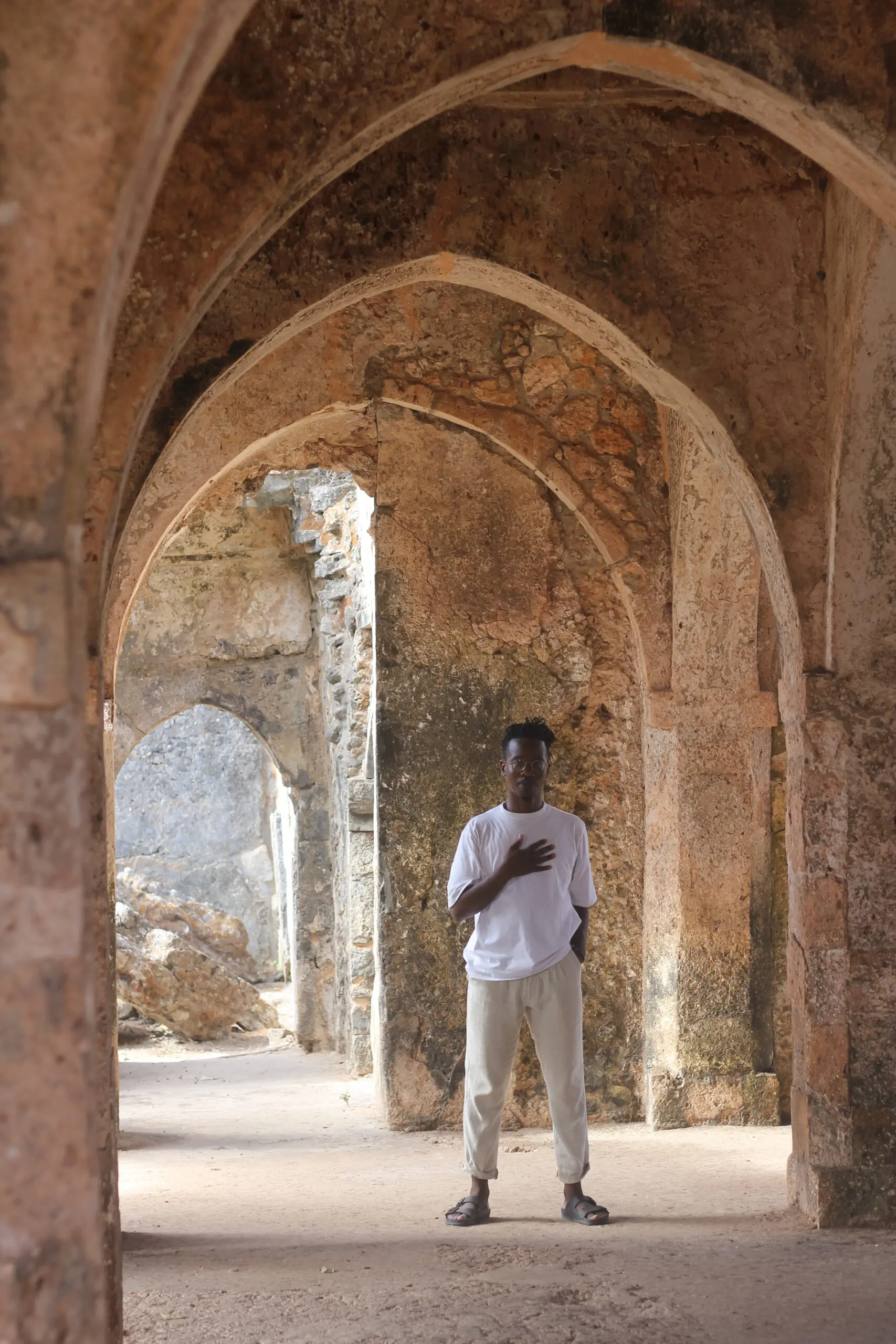
I am standing in the shade of a baobab growing alongside the ruins of the Grand Mosque at Kilwa Kisiwani, Tanzania. The island is a stop on the Misafara tour. I do not know how old the tree is. Baobabs are notoriously difficult to age, and some live a thousand years or more. Looking at this one, I find myself wondering how much of Kilwa’s history it has seen. A baobab here, if not this one, may have stood long enough to watch the city pass from success to sacking, from habitation to abandonment, from abandonment to excavation, from excavation to heritage site.
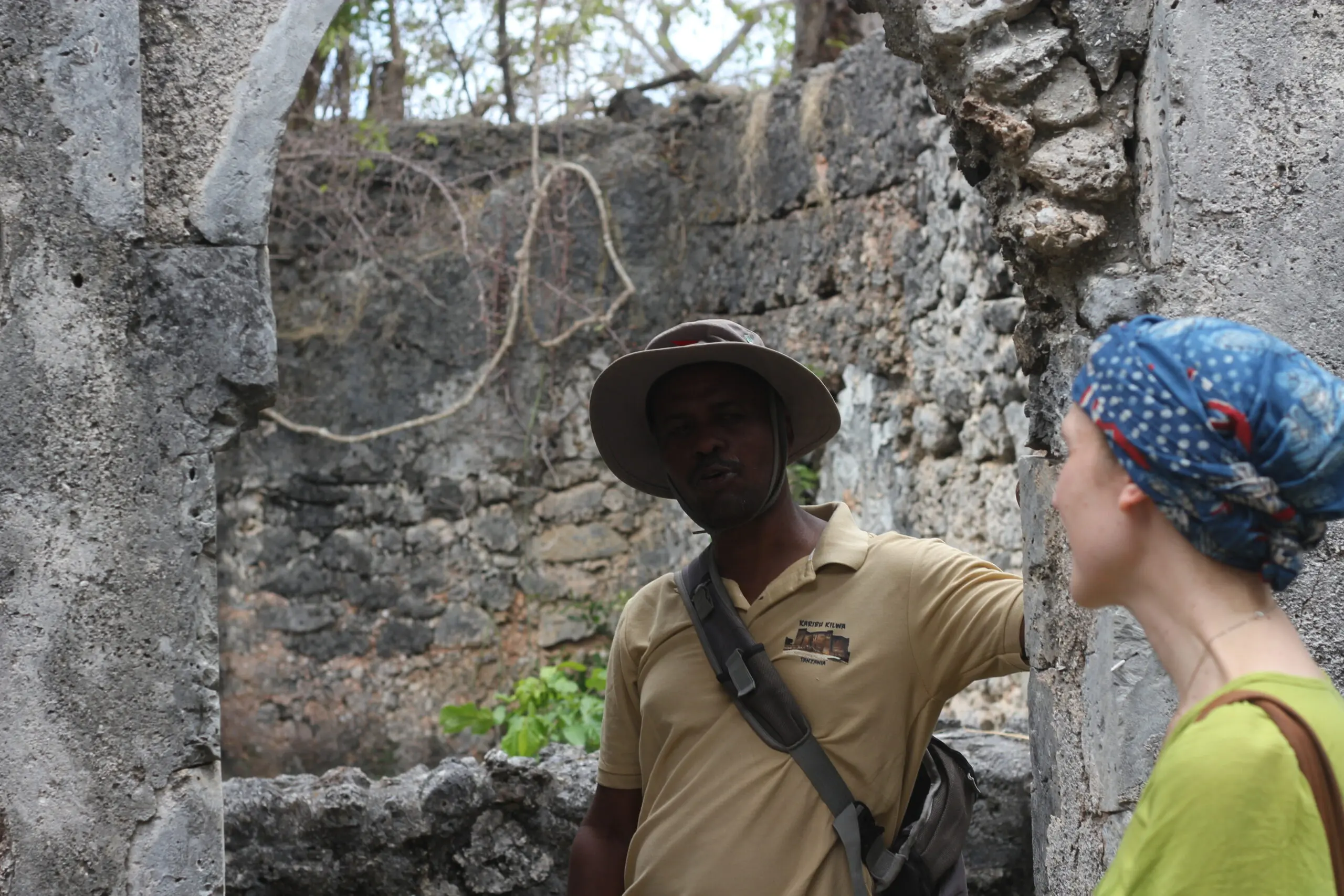
Our guide is telling us about the Portuguese. They came at the beginning of the sixteenth century, he explains, attacking and eventually taking control of Kilwa as Portuguese ships pushed into the Indian Ocean.
Standing beneath the baobab, listening to him, I begin thinking about another coast very far away.
Brasil.
On the afternoon of 22 April 1500, a Portuguese armada under Pedro Álvares Cabral, swinging wide into the South Atlantic to catch its winds, sighted a round mountain it named Monte Pascoal and a shore it named the Land of the True Cross, Vera Cruz, in what is now Bahia in Brasil’s Nordeste. Ninety-five days later, on 26 July of that same year, six of the thirteen vessels that had left Lisbon on the very same expedition were gathered off the island of Kilwa. Cabral met the emir, Ibrahim, in rowboats in the harbour and put a treaty before him. Ibrahim stalled. Cabral, worried about missing the monsoon to India, broke off the negotiations and sailed on.
Bahia in April, Kilwa in July. The voyage on which Cabral is claimed to have “discovered” Brasil was also the voyage that brought him to Kilwa. The same emerging maritime network that put Bahia and Kilwa on one voyage would, three centuries later, in the first half of the nineteenth century, help make possible the forced transport of hundreds of thousands of people from southeastern Africa to Brasil.
Brasil and Tanzania seem very far apart on a modern map. Follow the ships and trade winds rather than the borders, though, because the oceans have no borders and the currents connect them, and the distance changes. I have long felt an intense affinity with Brasil, and when I come to write about being there on this blog, the Refractive Index, I expect I will find myself following one of the rays refracting outward from Kilwa harbour. The histories set in motion by these early encounters remained entangled thereafter: differing from one another, yet continually deferring to one another.
Standing here, in Kilwa, in nearly one hundred degree heat, I press my palm against a wall and find it cool.
The walls are made from reef limestone and coral blocks set in lime mortar, their roofs once carried on mangrove timber and cut coral. Even under the coastal sun, the thick porous stone takes on heat slowly enough that the difference registers immediately on the body.
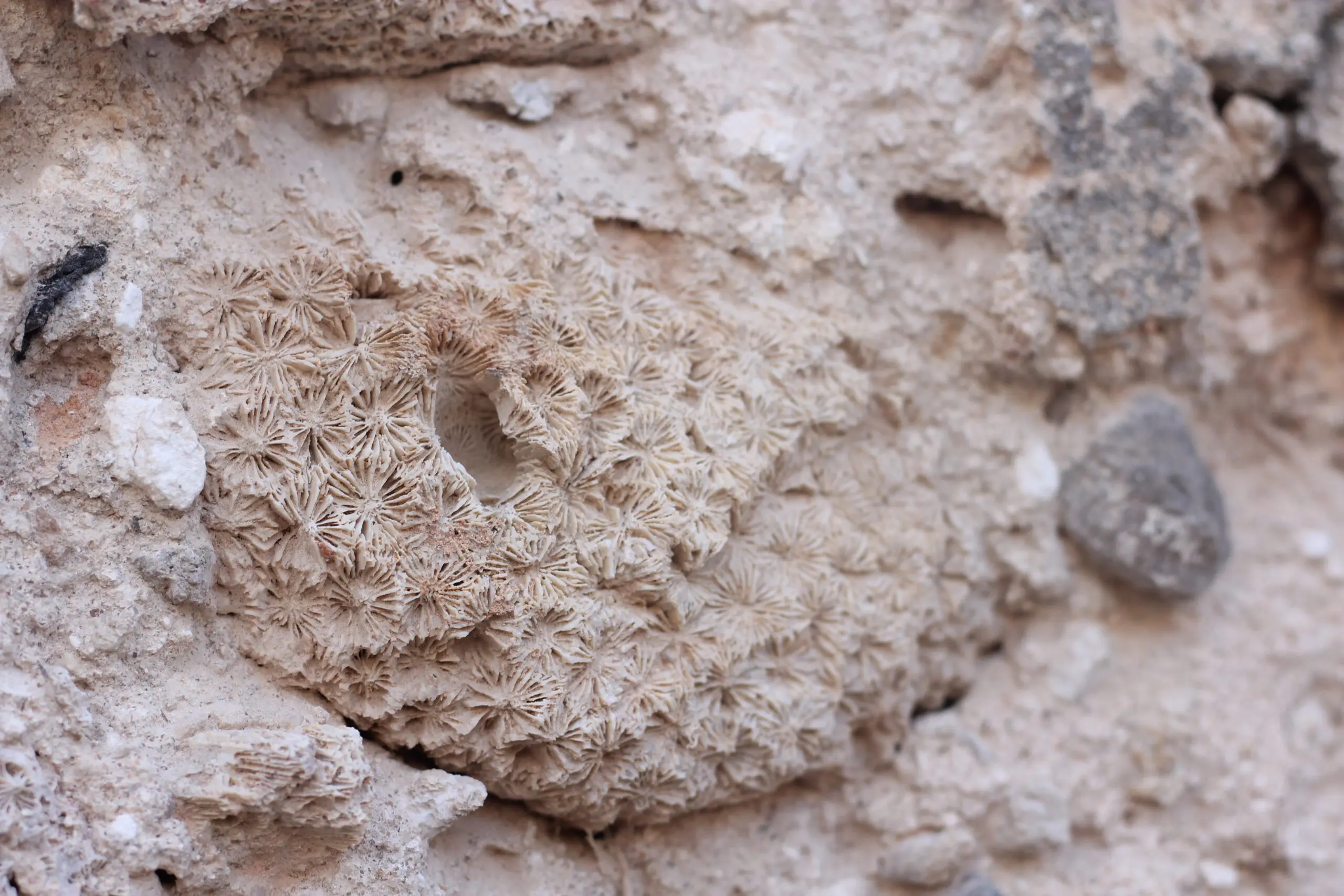
In places, the coral has not entirely surrendered the shapes of the creatures from which it was made. Their bodies are still visible inside the architecture. Coral polyps become reef. Reef becomes limestone. Limestone becomes wall. The Indian Ocean is quarried and raised into a building, and centuries after the building stopped being a building, it is still modifying the heat around a body that walked in this morning. Above it, baobabs have pushed their roots through what remains of the city, living mass passing through the accumulated bodies of an older marine world.
I am a person greatly troubled by the regard we show to ruins. Monumental civilizations are so often defined by their ruins, their glories projected backward into existence from the wreckage they leave behind. Too often, European colonizers arrived among peoples living in and around the remains of older cities, scoffed at the lives being made there, then excavated the stones beneath their feet, cordoned them off, catalogued them, conserved them, and celebrated them as artifacts of human achievement. The civilization was in the dead ruins; the living people were merely living among ruins. What had been reused, weathered, built over, inhabited differently, or simply allowed to decay became evidence of decline. Preservation, in such cases, begins to look less innocent. To preserve might be to take the colonizer’s side against the inhabitant: to value the dead building more highly than the living uses that succeeded it.
Our guide is standing a few metres off, waiting for me to catch up with the group. As a boy, he climbed these trees and walls. As a man, he now explains them to visitors. He remarks that Kilwa was being lived in while it was being preserved, and wonders at how conservation that kept the walls also drew a line through the island’s ordinary use of them. He is not bitter about it. There is melancholy in his reminiscences, yes, but there is also resolve in his dedication to his work.
With my hand on the cool wall, though, I realize that my troubles presumed the building dead, but my hand is telling me otherwise. The wall is not a relic of thermal engineering. It is thermal engineering, still working, still doing the one thing it was raised to do. And it is doing so through the fossilized bodies of a marine world older than the city, bodies Kilwa integrated into its architecture and made into a machine for living.
So the ruin refuses to remain simply a ruin. Kilwa is made from accumulated bodies and accumulated crossings.
Long before Portuguese ships appeared off this coast, Kilwa had already belonged for centuries to an Indian Ocean world whose roots here reached back at least to the tenth century. That world was organized by movements much older than European colonial empire. The regular monsoon winds made recurrent passage across the ocean possible. Sailors and merchants learned their rhythms and traveled with them, moving between the East African coast, Arabia, Persia, India, and lands farther east. Islamic commercial networks spread around the Indian Ocean rimland through these recurrent crossings, carrying people, goods, languages, beliefs, technologies, and stories back and forth for centuries.
The Swahili Coast of East Africa forms the western shores of this oceanic world.
The Swahili language, Kiswahili, is one of the best ways of understanding what we mean by Refracting Africa. It was formed through long histories of movement, settlement, borrowing, trade, religion, conquest, and adaptation. Its structure is East African, Bantu at the bone, while its fleshed-out vocabulary bears abundant traces of Arabic, Persian, Portuguese, Hindustani, German, and English. Sawāhil (سواحل), the Arabic word from which Swahili derives, means “coasts” or “shorelines.”
Shine Swahili through a prism and those linguistic worlds appear superposed inside a single tongue. A refracted ray is not a compromise between air and water: when light enters water, its speed changes and its path bends according to the properties of the medium it has entered. Swahili is likewise not a compromise among its sources. It is what these linguistic materials became through encounter on the East African coast, bent by the particular histories, peoples, rhythms, and social worlds through which they passed. Its Africanness does not survive despite those crossings. It is made through them.
From the thirteenth through the sixteenth centuries, Kilwa was among the most prosperous cities of the Swahili Coast. Its merchants handled gold and silver, pearls and perfumes, Arabian ceramics, Persian earthenware, Chinese porcelain, and goods arriving from the African interior. Inland gold traveled toward the coast. Ceramics crossed the ocean on the monsoon. Porcelain traveled farther still. Traders gathered and redistributed all of it through networks whose reach exceeded any single kingdom or coast. When the great traveler Ibn Battuta came through in the fourteenth century, he encountered an established, resplendent Muslim city embedded in a cosmopolitan oceanic system. He counted Kilwa among the most beautiful cities he had ever seen.
The Portuguese arrival and conquest mark not the beginning of Kilwa’s globality but a rupture inside an older global order: the intrusion of a violent and rapacious new maritime power intent on forcing itself into existing networks, seizing their strategic points, redirecting their commerce, and subjecting their movement to a new imperial logic.
Seen from the ruins, then, the story begins to refract again. The Indian Ocean world does not merely pass through Kilwa in ships, ceramics, metals, perfumes, languages, and people. The ocean itself is recorded in the fossilized bodies that form the city’s walls, the wider world is metabolized in and by its language, and Africa moves outward from this coast even as Arabia, Persia, India, China, and Europe move through the coast and into it.
The baobabs keep growing among the stones.